
For each set of three sentences, think of ONE word that can be used appropriately for all three sentences.
Trio #1
1. He was afraid that his revolutionary proposals would ___________ with strong opposition from hardliners.
2. The Chinese factories were operating non stop churning out shoes to ___________ the demand in Europe and the US.
3. With only 200 dollars a month, the family struggled to make ends ___________ .
Trio #2
1. The birds build their nests in early September and begin to ___________ their eggs two weeks later, always being on the lookout for predators.
2. The press speculated whether the new telecommunications company was going to ___________ cables on the seabed to improve the existing system.
3. One of my responsibilities at home is to ___________ the table in the evening.
Trio #3
1. It's irritating that they do nothing but ___________ lies about our family. The whole village is about to believe their incredible stories.
2. Don't allow the educational system to restrict your thinking abilities. I urge you to ___________ your wings and do things your way.
3. He opened the jar, took out some jam with his knife and ___________ it evenly on the warm toast.
Trio #4
1. Marijuana is not regarded as a ___________ drug. That's why some countries are thinking of letting people use it, at least for medical purposes.
2. It's ___________ to believe that there are no good people out there. I'm sure you can find some good-natured individuals in this area.
3. I'm trying to spare you learning things the ___________ way. Follow my advice and you don't need to make mistakes.
Trio #5
1. The latest ___________ in The New York Times was not favourable. He felt the morac was underrated.
2. At the end of your first year at work we will ___________ your salary and give you a company car.
3. The reclusive dictator showed up at a military parade to ___________ his troops and show his defiant opponents he was still in power.
Trio #6
1. Blankets and shelters were in ___________ supply in the aftermath of the disaster.
2. Nobody in this business knew his real name. He was called Bill for ___________ .
3. She reacted angrily when her name hadn't been included on the ___________ list.
Trio #7
1. Though the movie was widely ___________ across the country, the sales were a disappointment for the studio.
2. For a woman to get ___________ in the business world seems to be a tall order in a predominantly male environment.
3. This web site was shut down soon after the Internet provider realized it ___________ extreme views inciting violence.
Trio #8
1. Holmes immediately spotted two ___________ marks on the neck of the victim which he thought might have been left by a snake of some kind.
2. Don't ___________ the hand that feeds you. It was me who got you promoted and now, Ron, you're plotting behind my back. Shame on you!
3. 'Fred, can I have some of your apple?' 'Sure. Have a ___________ .
Trio #9
1. I'm absolutely ___________ the horse will win the race. There's no doubt about it.
2. It came as a shock to her husband when she tested ___________ for a sexually transmitted disease.
3. The guru stresses the power of ___________ thinking in his lectures, saying it helps to overcome problems and reduce strain.
Trio #10
1. It was one of the gang's members that ___________ the agent's cover as he'd seen him in uniform before.
2. Feeling tired, Lind put away the book, ___________ out the candle and went to sleep.
3. Separatists ___________ up several bridges in the province sending a violent message to the capital.
Showing posts with label vocabulary. Show all posts
Showing posts with label vocabulary. Show all posts
Friday, 26 February 2010

Monday, 22 February 2010
Word Game available for Download

Not so easy, but it's addictive! And it will expand your vocabulary.
The game has 5,000 words, so there should be enough to keep you scratching your head - and learning - for months.
It's easy to download and it's only a small file (6MB).
Click HERE to download.
Thursday, 11 June 2009

Wednesday, 10 June 2009
The Most Famous Verbal Slip Of All Time?
It's one small step for man,
one giant leap for mankind.

These are the famous words spoken by Neil Armstrong in 1969 as he climbed out of the lunar module and onto the moon's surface.
But... he got his "famous words" wrong.
Do you know why?
Answers in the COMMENTS below.
one giant leap for mankind.

These are the famous words spoken by Neil Armstrong in 1969 as he climbed out of the lunar module and onto the moon's surface.
But... he got his "famous words" wrong.
Do you know why?
Answers in the COMMENTS below.
Tuesday, 9 June 2009
Idioms Ahoy! Why's he talking about Clouds?
Always on the lookout for those puzzling - but useful - idioms! It's a never ending task!
 Here are three idiomatic expressions which mention 'cloud'.
Have you ever heard any of these? If not, see if you can work out what they mean by reading the text below.
 What a dreamer Mbak Tatik is! She daydreams about this, she imagines that
 . Sometimes the things she talks about are real. Sometimes they are not. When you see her staring out the window at nothing in particular, you know she has her head in the clouds. But actually some people at the Wisma are a little unhappy with her. Ari Wibowo came to the front office and asked about studying at the Wisma but Tatik had her head in the clouds and didn't persuade him to take the General Course. Yuan, Prima, Siwi - they were all angry with her. But she wasn't under a cloud for long. 'Mas' Ari came back the next day and asked for more information and Yuan, Prima and Siwi just so happened to be hanging out in the front office. So... every cloud has a silver lining!
Can you figure out what the expressions mean?
Try ... before you look at the explanations below!
Here are the definitions:
Every cloud has a silver lining - there are good things even in seemingly bad situations
To be under a cloud - to be under suspicion or to be out of favour
To have your head in the clouds - to daydream or to be unrealistic
 Here are three idiomatic expressions which mention 'cloud'.
- Every cloud has a silver lining
- To be under a cloud
- To have your head in the clouds
Have you ever heard any of these? If not, see if you can work out what they mean by reading the text below.
 What a dreamer Mbak Tatik is! She daydreams about this, she imagines that
 . Sometimes the things she talks about are real. Sometimes they are not. When you see her staring out the window at nothing in particular, you know she has her head in the clouds. But actually some people at the Wisma are a little unhappy with her. Ari Wibowo came to the front office and asked about studying at the Wisma but Tatik had her head in the clouds and didn't persuade him to take the General Course. Yuan, Prima, Siwi - they were all angry with her. But she wasn't under a cloud for long. 'Mas' Ari came back the next day and asked for more information and Yuan, Prima and Siwi just so happened to be hanging out in the front office. So... every cloud has a silver lining!
Can you figure out what the expressions mean?
Try ... before you look at the explanations below!
Here are the definitions:
Every cloud has a silver lining - there are good things even in seemingly bad situations
To be under a cloud - to be under suspicion or to be out of favour
To have your head in the clouds - to daydream or to be unrealistic
Sunday, 7 June 2009
Vocabulary Book - 100 Everyday Idioms
Here's a useful book explaining 100 commonly used metaphors (i.e. idioms)
 What did you say?
What do you mean?
The metaphors are arranged alphabetically, based on the first noun – if there is one. If there is no noun, then the order is taken from the main word that doesn’t change, such as “backwards” in “bend over backwards” (people sometimes say “lean over backwards”).
I each case there is an explanation of what the idiom means, why or when people use it, plus examples.
Download it here. Slightly bigger file than usual (almost 6MB), hope it's ok for you.
Here's an example from the book:

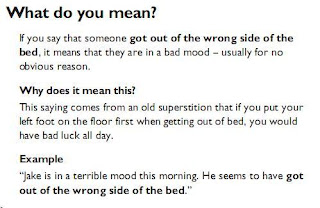
Any reactions to this book? Was it useful? Write your thoughts or requests for other kinds of book in the COMMENTS section below.
 What did you say?
What do you mean?
The metaphors are arranged alphabetically, based on the first noun – if there is one. If there is no noun, then the order is taken from the main word that doesn’t change, such as “backwards” in “bend over backwards” (people sometimes say “lean over backwards”).
I each case there is an explanation of what the idiom means, why or when people use it, plus examples.
Download it here. Slightly bigger file than usual (almost 6MB), hope it's ok for you.
Here's an example from the book:


Any reactions to this book? Was it useful? Write your thoughts or requests for other kinds of book in the COMMENTS section below.
Tricky Words
 Some people have trouble using the words SEE, LOOK and WATCH correctly.
Try these. Can you fill the gaps with the word SEE, LOOK or WATCH (or some other form of them)? Sometimes more than one answer is possible.
1) You can't ____ far in this heavy rain.
2) Anton and Jack ____ good tonight.
3) Did you ____ Empat Mata last night?
4) ____ out for pickpockets!
5) Can you ____ the blue car on the left?
6) ____ you tomorrow after work, ok?
7) It ____ like rain, doesn't it?
8) Oh yes, I ____ what you mean.
9) What's wrong? You ____ really unhappy.
10) I'm afraid Linda has to ____ the doctor.
Some of these are a little tricky, don't you think?
Give us your answers to the 10 questions above in the COMMENTS below.
See if this guideline helps:
look -to pay attention, to try to see what is there (if look is followed by an object, you must use a preposition which is usually 'at'); to seem or appear - examples: Look at the board, please; this assignment looks unfinished; Have you looked in the drawer?'Look', 'see' and 'watch' are very similar. They are all ways of using our eyes. However, there are two very important differences. It depends on how you intend to look or watch and how intense the looking is.
see - to notice people and things with your eyes; visual impression; to understand; to visit - examples: Can you see the the blue car over there?; I see what you mean; It was so dark I couldn't see my hand in front of my face.
watch - to look at something for a period of time, usually something which moves or changes - examples: He watches TV in the evenings; Adrian has been watching his weight recently; watch what happens when I turn the volume control all the way up!
When we say 'see' we are normally talking about things we can't avoid – so for example, "I opened the curtains and saw some birds outside." - I didn't intend to see them, it just happened.
However, when we use the verb 'look', we're talking about seeing something with an intention. So, "this morning I looked at the newspaper" – I intended to see the newspaper.
When we watch something, we intend to look at it but we're also looking at it quite intensely, usually because it's moving. So, for example, "I watched the bus go through the traffic lights." "I watched the movie." We want to see it, we're looking at it intensely and it's normally moving.
Idioms Ahoy! Why's he talking about Donkeys?
Always on the lookout for those puzzling - but useful - idioms! It's a never ending task!
Here are three idiomatic expressions which mention 'donkey'.
Have you ever heard any of these? If not, see if you can work out what they mean by reading the text below.
If you want to know the Wisma Bahasa gossip, talk to Mas Sugeng because he's been here for donkey's years. In fact he's been here so long he can remember when the Wisma Bahasa was still in Jalan Cenrawasih. If you ask him to tell you stories he'll talk and talk and talk. In fact no one can talk the hind legs off a donkey as well as he can! The teachers think they're so great but it's Mas Sugeng who does the donkey work that makes everything run smoothly at the Wisma Bahasa in the evenings: preparing the classrooms, answering the phone, greeting the students, finding the teachers, and generally keeping an eye on things.
Can you figure out what the expressions mean?
Here are the definitions:
Donkey work - necessary but boring routine work
For donkey's years - for a long time
To talk the hind leg off a donkey - to talk too much
Here are three idiomatic expressions which mention 'donkey'.- Donkey work
- For donkey's years
- To talk the hind leg off a donkey
Have you ever heard any of these? If not, see if you can work out what they mean by reading the text below.

If you want to know the Wisma Bahasa gossip, talk to Mas Sugeng because he's been here for donkey's years. In fact he's been here so long he can remember when the Wisma Bahasa was still in Jalan Cenrawasih. If you ask him to tell you stories he'll talk and talk and talk. In fact no one can talk the hind legs off a donkey as well as he can! The teachers think they're so great but it's Mas Sugeng who does the donkey work that makes everything run smoothly at the Wisma Bahasa in the evenings: preparing the classrooms, answering the phone, greeting the students, finding the teachers, and generally keeping an eye on things.
Can you figure out what the expressions mean?
Here are the definitions:
Donkey work - necessary but boring routine work
For donkey's years - for a long time
To talk the hind leg off a donkey - to talk too much
Thousands of languages are disappearing

NEWS FLASH!

The United Nations cultural agency, UNESCO, says more than a third of the world's six thousand languages are in danger of extinction. Of those two thousand, it says, about two hundred are spoken by only a handful of people.
Download and listen to this news story here.
Here is the text:
When a language dies, UNESCO says the world loses valuable cultural heritage - a great deal of the legends, poems and the knowledge gathered by generations is simply lost. In 2008, Alaska's last native speaker of Eyak died, taking the language with her.
Chief Marie Smith Jones, praying here for the survival of the Eyaks. She died at the age of eighty-nine, campaigning to save her people's heritage.
UNESCO says government action is needed if the world is to preserve its linguistic diversity. People must be proud to speak their language to ensure it survives.
In the last five years, the governments of Mexico, New Zealand and the United States managed to reverse the trend locally. But UNESCO says the phenomenon of dying languages appears in every region and in very diverse economic conditions.
Here are some of the words and idioms used in the news report:
- UNESCO - short for the United Nations Educational, Scientific and Cultural Organization
- valuable cultural heritage - features belonging to a particular society, such as traditions, languages, buildings or works of art, which still exist from the past, are unique and therefore have a historical importance
- a great deal of - many, a lot of
- legends - old stories presented as history but unlikely to be true
- native speaker of... - someone whose first language, or mother tongue, is...
- campaigning - taking action aimed at achieving a goal
- to preserve its linguistic diversity - to save the great number of languages currently spoken
- to reverse the trend - to make sure people are encouraged to speak rare languages, so those languages can survive
Any thoughts on this?
There are many problems in this world. Is 'disappearing languages' something for us to worry about?
Do you speak a language that is disappearing?
How many of you will not teach your children the mother tongue your parents spoke and used with you?
Is English your second language? Third language? Fourth language?
Comments, thoughts, opinions in the COMMENTS below please.
We apologize on behalf of Bahasa Inggris, part 1
There are no less than NINE phrasal verbs that use the verb "ask" + a preposition.
How many of them do you know already?
A. What does 'Ask after' mean?
How many of them do you know already?
A. What does 'Ask after' mean?
- Enquire about someone's health, how life is going
- Give assistance
- Die
- To invite somebody into your house
- Move at the same rate
- Drive a vehicle as fast as possible
- Request to have or be given
- Mean
- Experience different times
- Arrive in large numbers, for military vehicles
- Invite
- Lose hair
- Attack
- To provoke a negative reaction
- Hit and injure someone
- Invite someone
- Explode
- Emit pollution or something else unpleasant
- To invite someone for a date
- When trouble starts
- Visit
- Stop holding (but withdraw support gently)
- Invite someone
- Understand fully
- Use money earned
- Ask a number of people for information of help
- Make someone feel more positive
Saturday, 6 June 2009
Electronic Dictionary for your computer

The IndoDic E-kamus is a downloadable, Windows-based electronic dictionary and translating tool which lets you access the TruAlfa Indonesian and English translation dictionaries without an internet connection. The IndoDic E-kamus is free for personal use.
DOWNLOAD it here.
Click on this graphic for a screenshot:

Tall People Earn More Money
NEWS FLASH!
Researchers in Australia have found that tall people earn higher wages than shorter people. An extra ten centimetres in height means 3% higher wages. They also found that chubby people earn more than those who are skinnier.
Download and listen to this news story here.
Here is the text:
The long and short of this Australian report is that tall workers earn significantly more than their vertically challenged counterparts. A six foot man can expect a windfall of almost $750 a year. The researchers found there were practical reasons why the size gap translated into a pay gap. Tall people were sometimes more capable of performing certain physical tasks, like reaching high shelves. But the discrepancy is explained mainly by discrimination, the simple fact that society tends to look on tall people as more powerful and smarter, even when they're not. The study from the Australian National University also found that slimmer workers tend to get slimmer pay packets. Fat men earn 5% more than their slender colleagues.
Here are some of the words and idioms used in the news report:
the long and short of = a commonly used set expression said when you want to explain the general situation without giving details
vertically challenged = an indirect way of saying 'short'
counterparts = your counterpart is someone who is generally similar to you but different in a particular way (e.g. they come from a different country, or, as here, they are shorter than you)
windfall = money that you win or receive unexpectedly
translated into = meant, caused, resulted in
discrepancy = a distinct difference between two things that should be the same
discrimination = unfair treatment of someone because of prejudice about race, ethnicity, age, religion, gender or, as here, size
tend to get slimmer pay packets = usually earn less money
slender = slim, thin
Any thoughts on this?
Answers in the COMMENTS please!
Subscribe to:
Posts (Atom)